
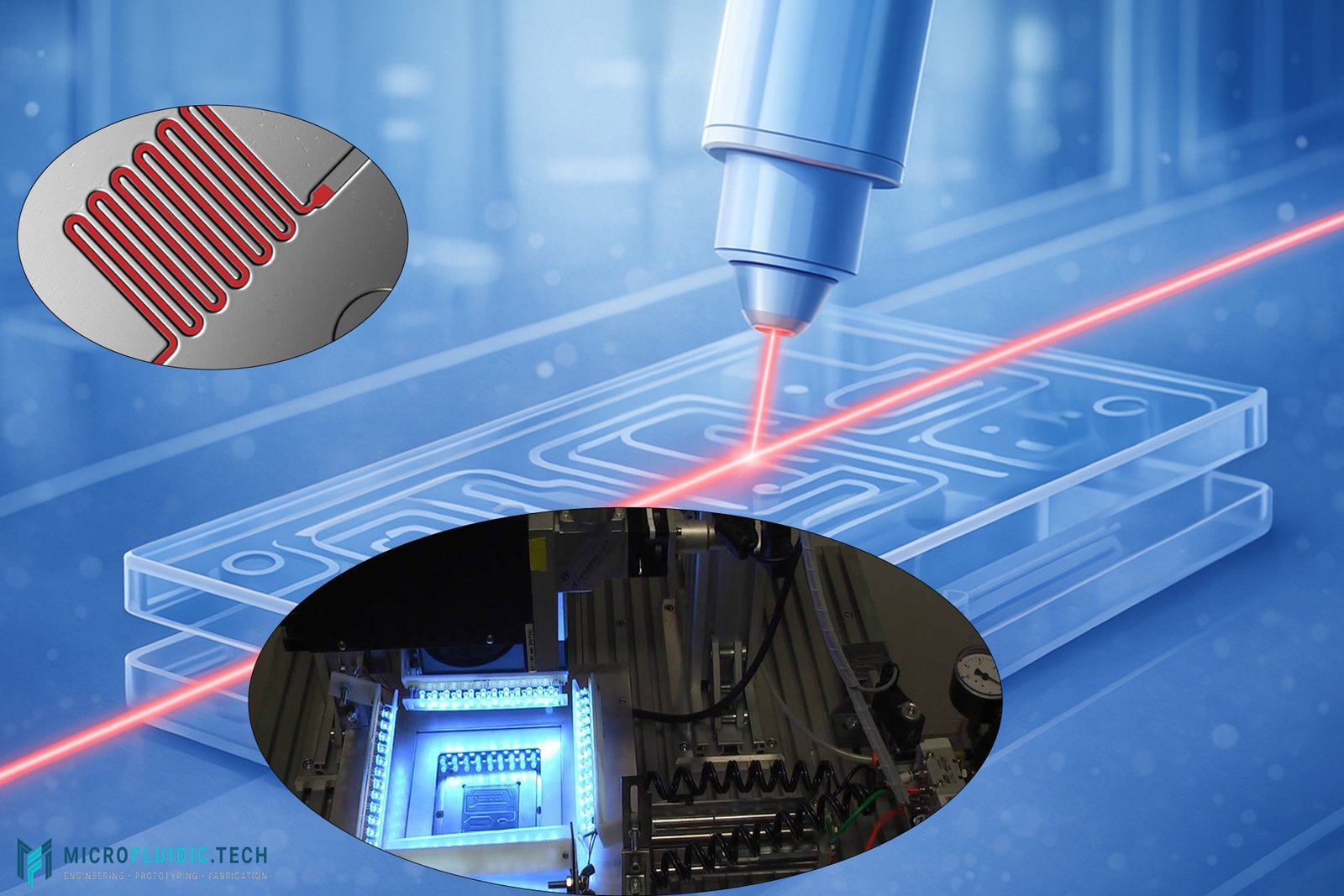
Laser Transmission Welding: A High-Performance Sealing Solution for Microfluidic Cartridges
Introduction
Sealing microfluidic cartridges is one of the most critical engineering steps in building reliable point-of-care diagnostic systems and lab-on-a-chip devices. These platforms often incorporate heat-sensitive biomolecules, such as antibodies or enzymes, that must remain fully functional throughout fabrication. Any excessive heat, contamination, or mechanical stress during the sealing process can compromise the entire assay.
To address this challenge, a study by Mäntymaa et al. (2011) investigated whether laser transmission welding—a technique widely used in medical-grade plastic manufacturing—could be safely applied to microfluidic immunoassay cartridges. Their results reveal that laser welding not only preserves assay performance but can also enhance device reproducibility when compared to traditional adhesive sealing.
Why Sealing Matters in Microfluidics
A microfluidic cartridge may be small in size, but its requirements are highly demanding. Effective sealing must:
-
prevent sample leakage
-
protect sensitive biomolecular surfaces
-
maintain consistent channel geometry
-
support high-throughput production
-
ensure long-term storage and device stability
Traditional methods such as adhesive taping and thermal bonding often introduce their own complications—ranging from trapped contaminants and uneven pressure to excessive heat exposure. These issues become especially problematic when the reaction chamber already contains immobilized antibodies or antigens.
This is where laser transmission welding stands out. By enabling precise, localized heating and strong polymer-to-polymer bonding, it offers a clean, scalable, and repeatable sealing solution.
Study Overview
The study compares two sealing techniques applied to a polystyrene microfluidic cartridge designed for a TSH (thyroid-stimulating hormone) immunoassay:
-
Laser-welded sealing with a polystyrene cover
-
Adhesive tape sealing as a traditional benchmark
To evaluate performance, researchers examined:
-
assay signal response
-
dose–response curves
-
coefficient of variance (CV) among parallel samples
-
localized heat impact during welding
Polystyrene was chosen due to its optical clarity, low autofluorescence, and strong compatibility with surface chemistry for biomolecule attachment—making it a widely used material for diagnostic cartridges.
Key Findings
1. Preserved Assay Performance
The dose–response curves from laser-welded cartridges matched those from adhesive-sealed devices. This confirms that the welding process does not disrupt immobilized biomolecules or interfere with reaction kinetics.
2. Enhanced Reproducibility
Laser-welded devices displayed lower CV values, meaning measurements across identical samples were more consistent. For commercial diagnostics, this level of repeatability is essential and directly impacts quality control.
3. Controlled Thermal Exposure
Thermal imaging and embedded temperature sensors showed that channel temperatures remained well within safe limits when welding parameters were optimized. This ensures compatibility with pre-functionalized reaction chambers containing delicate biological reagents.
4. Manufacturing-Friendly Process
Laser transmission welding supports:
-
rapid cycle times
-
high-throughput fabrication
-
low per-unit cost
-
cleanroom-friendly operation
-
full automation capabilities
These strengths make it a prime candidate for scaling microfluidic products from prototype to mass production.
Benefits for Device Designers and Manufacturers
For engineers and product developers building next-generation microfluidic systems, laser transmission welding offers several advantages:
-
No adhesives required, eliminating the risk of chemical contamination
-
Strong, hermetic seals that withstand pressure and long-term storage
-
Excellent optical clarity, ideal for fluorescence or absorbance detection
-
Improved repeatability, strengthening QC processes
-
Material versatility, compatible with polystyrene, COC, COP, and PMMA
This makes the method especially well-suited for disposable diagnostics, point-of-care testing devices, and advanced biomedical sensors.
Conclusion
The study demonstrates that laser transmission welding is a safe, scalable, and performance-preserving sealing method for microfluidic immunoassay cartridges. Its ability to maintain assay integrity while improving reproducibility positions it as a superior alternative to adhesive-based methods.
As the microfluidics field moves toward greater commercialization and mass manufacturing, integrating industrial-grade laser welding becomes a strategic step toward creating more robust, reliable, and high-quality lab-on-a-chip solutions.
