
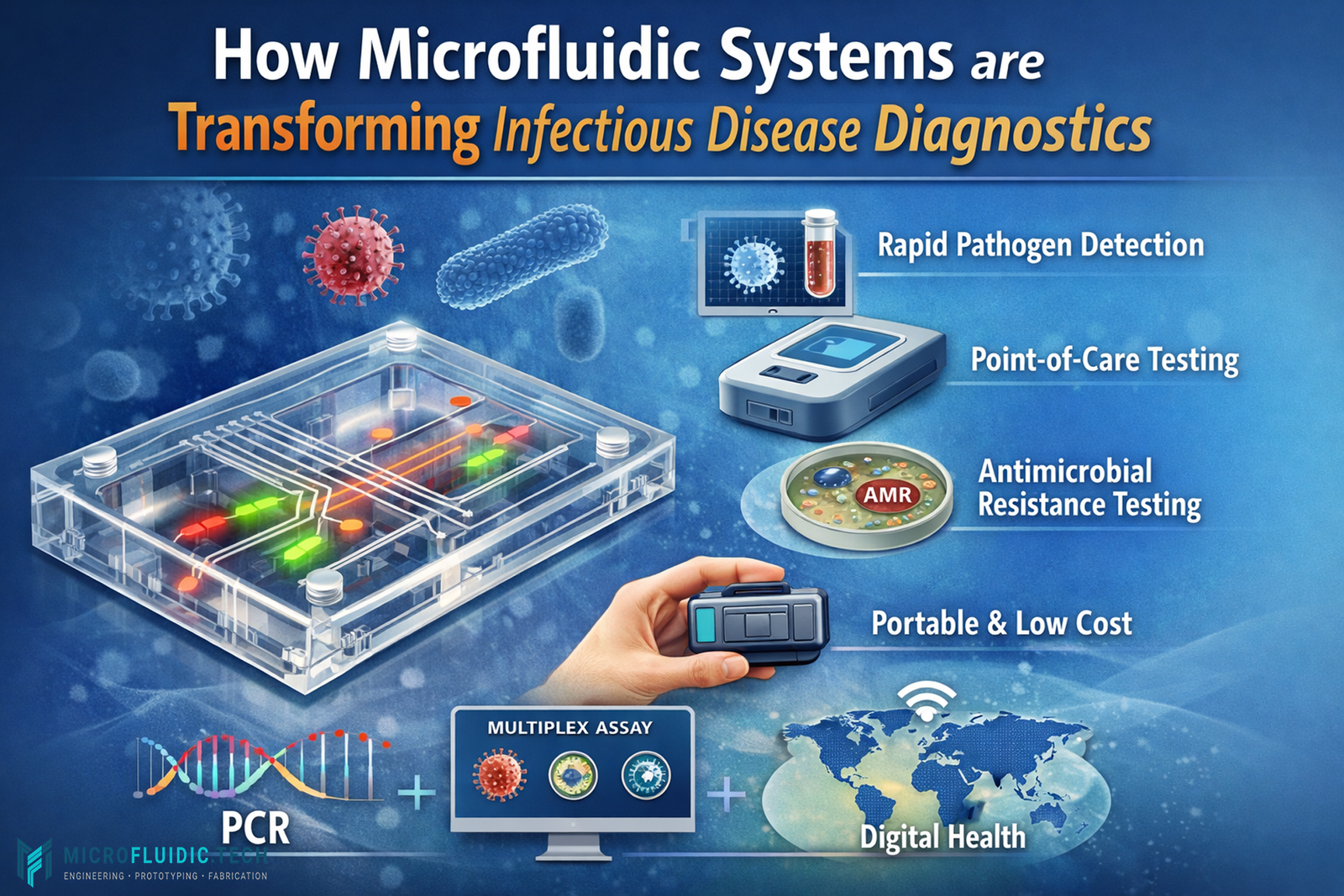
Microfluidic technologies — often called lab-on-a-chip systems — are emerging as powerful tools for rapid, sensitive, and low-cost infectious disease diagnostics. These miniaturized platforms manipulate tiny volumes of fluids using precisely engineered microchannels, enabling highly controlled reactions and complex analyses that traditional lab methods cannot match.
Infectious diseases continue to pose a major global health challenge, from widespread viral outbreaks to the rise of antimicrobial resistance (AMR). Conventional diagnostics often rely on slow culture techniques or centralized laboratory testing, leading to delays in diagnosis and treatment decisions — especially in low-resource settings
What Are Microfluidic Diagnostic Systems?
Microfluidic devices control fluid flow at the microscale, where forces such as viscosity and capillary action dominate. This precise control allows integration of multiple lab processes — including sample preparation, mixing, detection, and read-out — into a single compact platform. Materials like PDMS (polydimethylsiloxane) and paper-based substrates enable versatile designs, from continuous-flow channels to droplet and digital microfluidics.
Advanced Detection Strategies
Microfluidic diagnostics often incorporate biosensors and molecular assays such as:
-
Isothermal nucleic acid amplification tests (NAATs) for fast pathogen detection
-
CRISPR-based systems for ultra-sensitive genetic recognition
-
Electrochemical, optical, or plasmonic biosensors for real-time signal detection
These technologies enable accurate detection of respiratory viruses (e.g., SARS-CoV-2, influenza) and other pathogens within minutes to hours, with minimal sample handling and reduced reliance on large laboratory infrastructure.
Point-of-Care Applications
Because microfluidic systems can be manufactured as portable cartridges or integrated with handheld readers, they hold immense promise for near-patient and point-of-care (POC) use. This means faster diagnostic turnaround times, earlier treatment decisions, and better outbreak management, especially in underserved regions.
Disease Areas Covered
The review highlights advances across key clinical areas, including:
-
Respiratory infections (COVID-19, influenza, RSV)
-
Urinary and bloodstream infections with rapid antimicrobial susceptibility testing
-
Gastrointestinal pathogens
-
Sexually transmitted infections and vector-borne diseases
-
High-burden diseases like tuberculosis and malaria
Future Outlook
Microfluidic diagnostics are moving toward fully automated sample-to-answer platforms capable of multiplex detection — simultaneously identifying multiple pathogens from a single sample. Integration with digital health data, artificial intelligence, and wireless connectivity will further accelerate their adoption in public health and personalized medicine.
Conclusion: Microfluidic diagnostic systems are transforming how infectious diseases are detected and manag—offeringng speed, sensitivity, and accessibility far beyond traditional methods. As research continues to advance, these technologies could become cornerstones of global disease surveillance and point-of-care healthcare delivery.
https://pubs.rsc.org/en/content/articlehtml/2024/lc/d4lc00117f
