
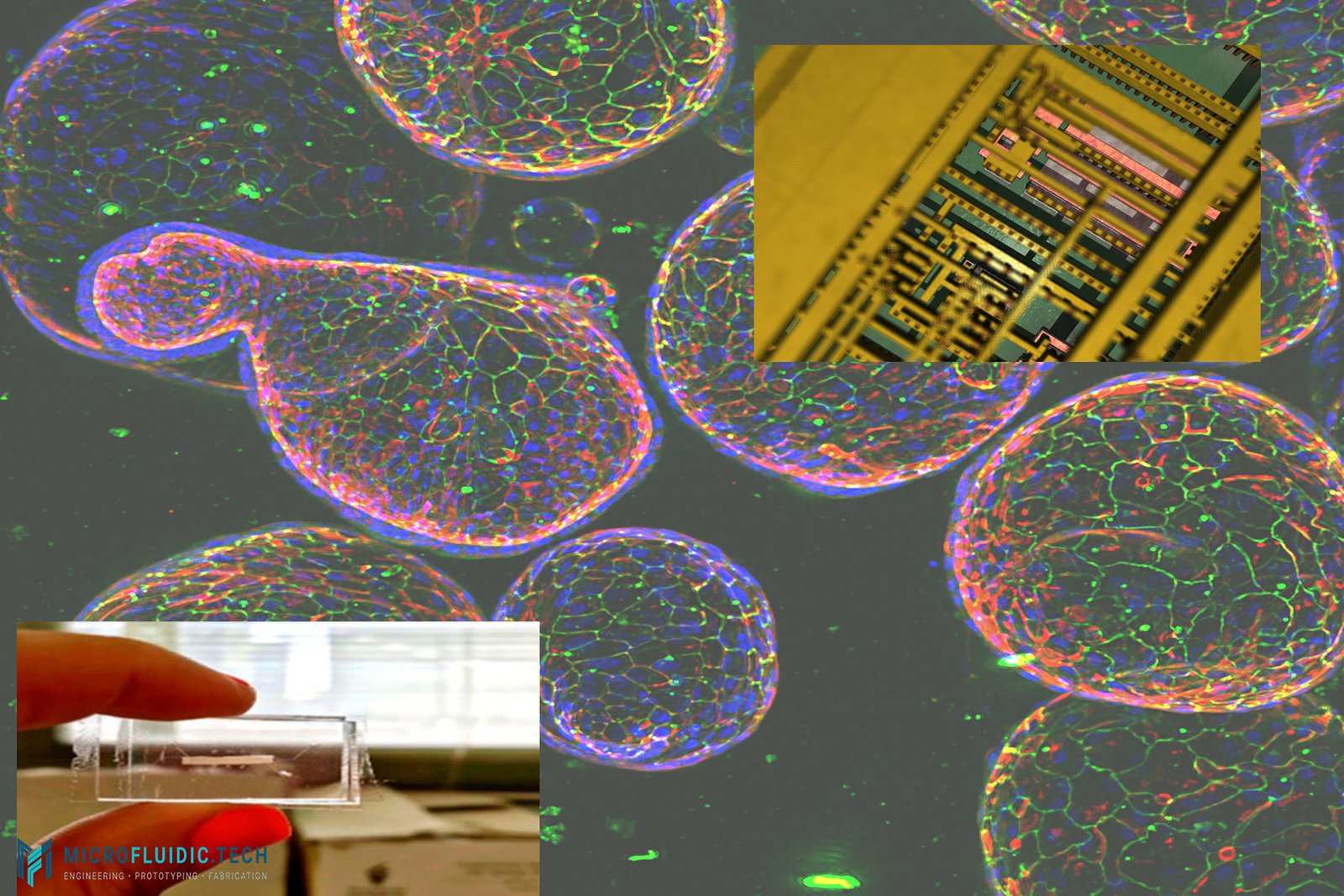
In the rapidly evolving world of microfluidics, the capability to reliably fabricate microscale channels and to functionalize surfaces is foundational. This section of the review article focuses on the techniques, materials, and strategies that underpin the fabrication and functionalization of microfluidic devices—a core enabler of lab-on-a-chip systems.
3.1 Materials and Fabrication Methods
Microfluidic device fabrication begins with choosing appropriate materials and techniques. Traditional materials such as silicon, glass, and elastomers (like PDMS) offer advantages in terms of optical clarity, chemical resistance, and micro-fabrication flexibility. The review highlights how these materials are adapted and combined to meet specific application needs.
Key fabrication methods include photolithography, soft lithography, hot embossing, and micromachining. Each carries trade-offs: photolithography and etching allow precise features in glass or silicon but can be costly. Soft lithography (e.g., molding PDMS) is comparatively accessible but may suffer from drawbacks such as absorption of small molecules. The article discusses how hybrid workflows—combining rigid substrates with elastomeric seals or patterned polymers—are being used to optimize performance.
3.2 Surface Functionalization & Integration
Once microchannels are fabricated, functionalization of surfaces becomes critical for performance. Surface treatment may involve cleaning, activation (e.g., plasma, UV), chemical modification (e.g., silanization), and deposition of biomolecules or coatings (e.g., extracellular-matrix proteins, antibodies).
Why is this important? Because in microfluidic devices, the surface-to-volume ratio is very high. The interactions of fluids and biomolecules with channel walls dominate transport, cell behavior, separation performance, and assay sensitivity. Proper functionalization ensures reproducible behavior: it supports cell adhesion (for cell culture chips), resists non-specific adsorption (for analytical assays), and enables integration of sensors or electrodes.
3.3 Challenges & Emerging Strategies
The review outlines key challenges in microfabrication and functionalization:
-
Fluidic leakage and bonding integrity: Ensuring reliable seals between substrates and channel layers is non-trivial, especially when combining dissimilar materials.
-
Material compatibility: Many microfluidic applications require biocompatibility, optical clarity, minimal autofluorescence, and chemical inertness. For instance, PDMS may absorb hydrophobic molecules, compromising assays.
-
Scalability and reproducibility: Moving from prototyping to mass production demands methods that are cost-effective, reliable, and capable of high throughput.
-
Integration of multiple functionalities: Incorporating valves, sensors, electrodes, and 3D architectures increases complexity.
To address these, the article reviews emerging strategies such as:
-
Hybrid material systems: Combining rigid and elastomeric layers or embedding sensors during fabrication.
-
Micro- and nano-patterned surfaces: Enhancing fluidic behaviors such as mixing, droplet formation, or cell guidance by introducing micro-textures or nano-coatings.
-
Modular microfluidic blocks: Designing standardized components that can be assembled like “building blocks,” enabling modular device architectures and faster iteration.
-
Bio-functional coatings: Using advanced surface chemistries to tether biomolecules, generate gradients, or create selective barriers.
3.4 Implications for Microfluidic Applications
The advances discussed in this section of the review have direct implications for the breadth of microfluidic applications: from cell culture and organ-on-chip systems to high-throughput screening and point-of-care diagnostics. With improved fabrication and functionalization, devices become more reliable, more reproducible, and more suited to real-world deployment.
In particular:
-
High-quality fabrication and surface control improve cell-based assays, where cell adhesion and microenvironment are critical.
-
Better functionalization enables analytical microfluidic assays, reducing non-specific binding and improving sensitivity.
-
Scalable, modular fabrication supports commercial microfluidic devices, bridging the gap between academic prototypes and marketable products.
3.5 Key Takeaways
-
Material choice and fabrication strategy must align with the intended application: e.g., biological vs. chemical, disposable vs. reusable, single-use vs. high-throughput.
-
Surface functionalization is not an afterthought—it is central to device performance.
-
Overcoming fabrication, bonding, and scalability challenges remains critical for the wider adoption of microfluidic technologies.
-
Emerging approaches such as modular microfluidics, hybrid materials, and biofunctional coatings are shaping the next generation of devices.
Conclusion
The “Microfabrication and Functionalization” section of the review brings into focus the often-underappreciated but absolutely essential engineering that enables high-performance microfluidic systems. For anyone engaged in microfluidic design, prototyping, or commercialization, understanding and applying these fabrication and surface strategies is a must. As microfluidics continues its push into real-world applications—diagnostics, organ-on-chip, drug screening—the engineering foundation discussed here will remain the foundation for success.
