
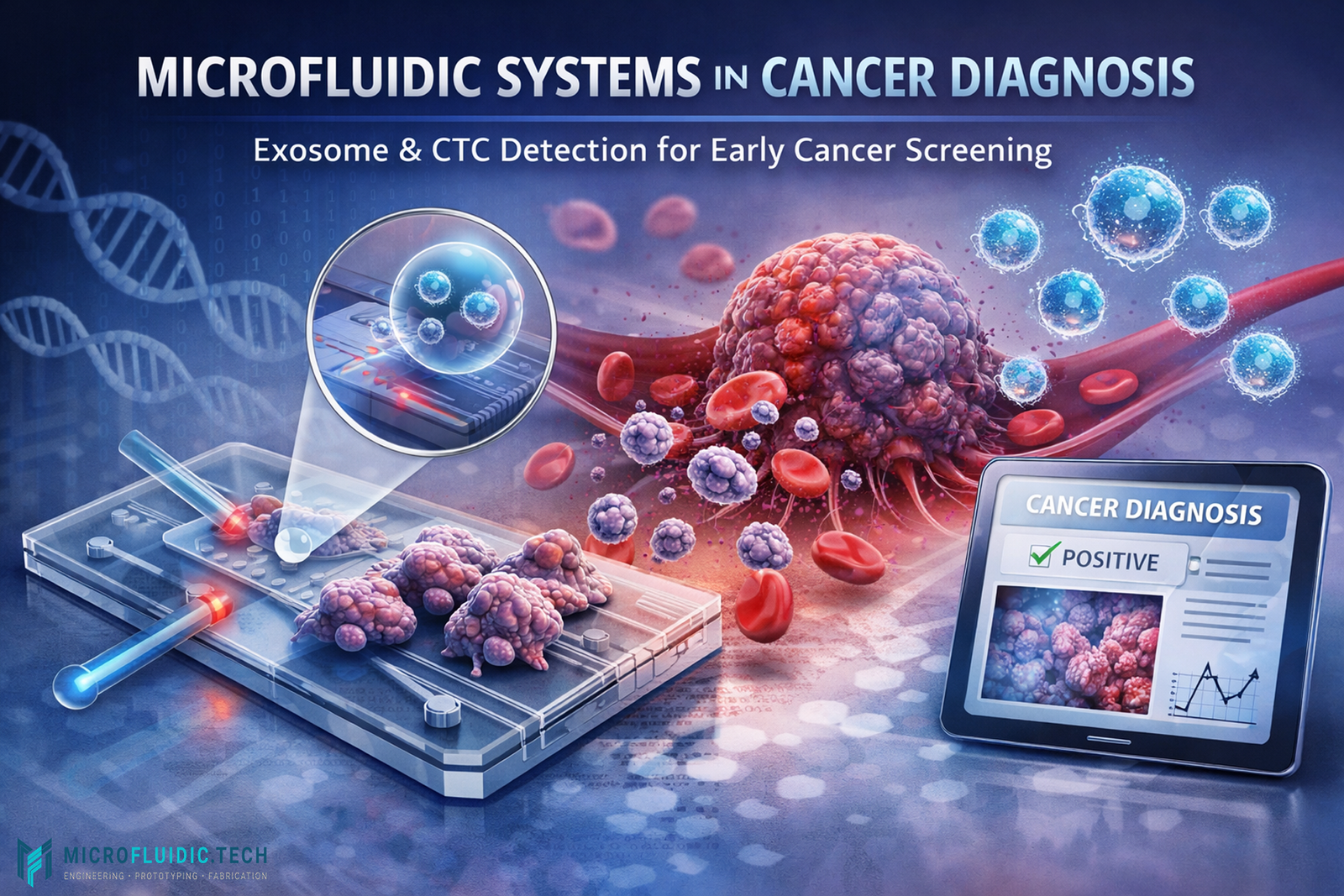
Cancer remains one of the leading causes of death worldwide. Early detection dramatically improves patient outcomes, but conventional diagnostic tools often fall short in sensitivity and speed. Liquid biopsies, which analyze cancer-related material in blood or other body fluids, are seen as a promising alternative.
Exosomes—tiny vesicles released by cells — and CTCs shed into the bloodstream by tumors contain vital molecular information about cancer progression and treatment response. However, their low abundance and heterogeneity make detection and isolation challenging with standard lab techniques.
Microfluidic Technology in Diagnostics
Microfluidics refers to the science and engineering of manipulating small volumes of fluids — typically at the micro- and nano-scale — within finely engineered channels. These systems excel due to:
-
Precise control of fluid flow
-
High throughput and sensitivity
-
Reduced sample and reagent use
-
Potential for automated, integrated workflows
Such attributes make microfluidic platforms ideal for detecting rare biomarkers in clinical samples—including exosomes and CTCs—much more reliably and efficiently than traditional lab methods.
Detection & Isolation Techniques
The article discusses several microfluidic approaches that enhance biomarker capture:
🔹 Hydrodynamic and Filtration Methods
These rely on channel geometry and fluid flow patterns to separate cells and vesicles based on size and physical properties.
🔹 Affinity-Based Capture
Surfaces within microfluidic devices can be functionalized with antibodies or ligands that specifically bind to target biomarkers (e.g., tumor-specific antigens on CTCs), allowing selective isolation.
🔹 Electrokinetic & Dielectrophoretic Forces
Electric fields are used inside microchannels to move and separate particles based on their electrical properties, improving sensitivity.
Each method has trade-offs in complexity, throughput, and integration with downstream analysis tools (e.g., molecular profiling).
Clinical Translation & Point-of-Care (POC) Integration
One of the biggest aspirations of the field is to move microfluidic diagnostics from the lab bench to clinical bedside use, particularly for POC applications. This means devices must be:
-
Portable and robust
-
User-friendly
-
Capable of delivering rapid, accurate results with minimal operator intervention
Integrating microfluidic systems with detection technologies (optical, electrical, or biochemical readouts) and automated sample handling will be key to achieving this vision.
source; https://onlinelibrary.wiley.com/doi/full/10.1002/nano.202400108
