
Introduction
Polymer welding plays a critical role in the fabrication of microfluidic devices, where precision bonding, optical clarity, biocompatibility, and mechanical integrity are essential. As microfluidic systems continue to advance in diagnostics, lab-on-chip platforms, biosensors, and organ-on-chip technologies, reliable bonding methods are becoming increasingly important.
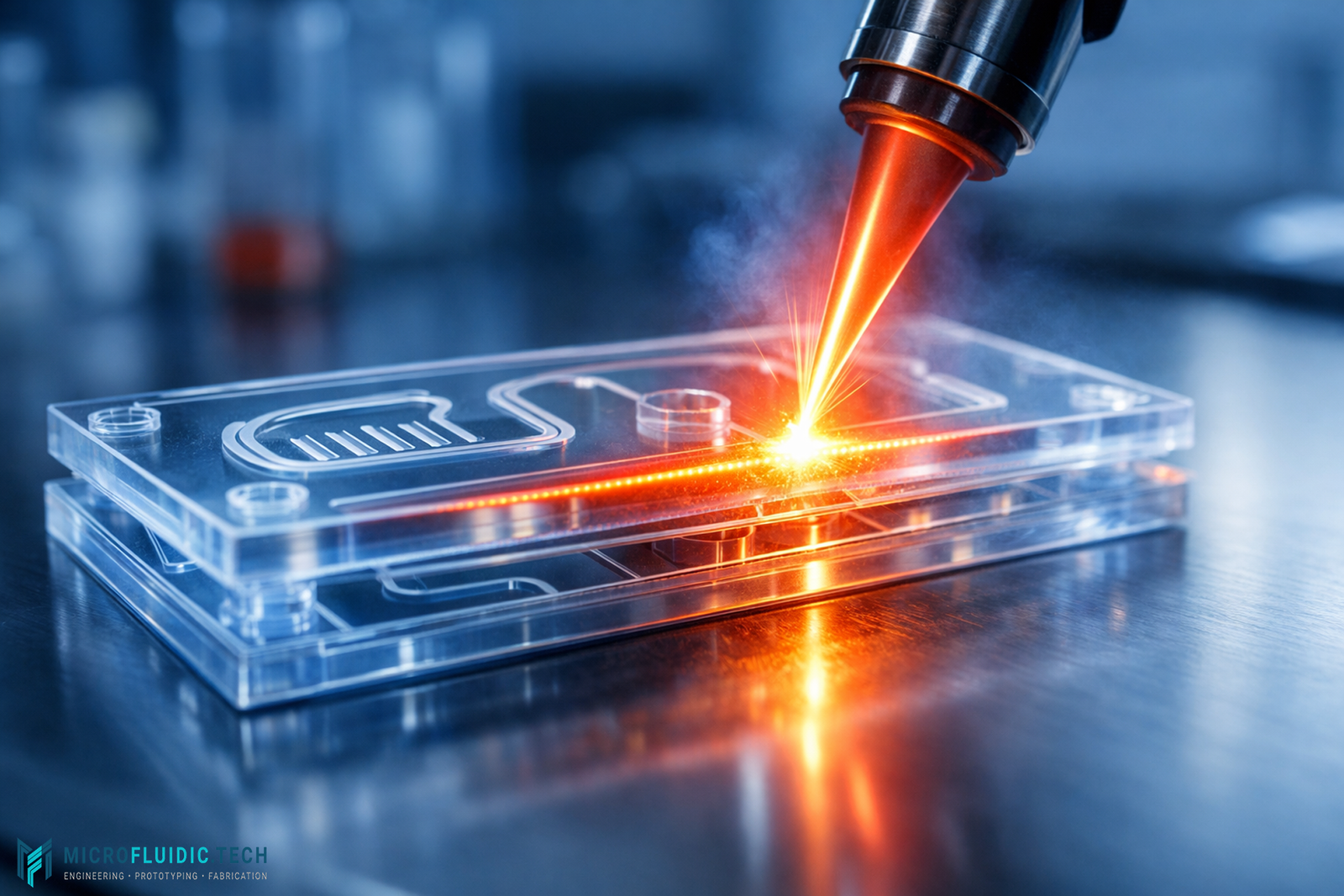
A pivotal study published in Optics & Laser Technology investigated absorber-free polymer welding using a 2 µm thulium fiber laser. The findings reveal significant opportunities for improving microfluidic device fabrication, particularly for biomedical and optical applications.
This article provides a comprehensive overview of polymer welding technologies, with special emphasis on laser welding at mid-infrared wavelengths and its relevance to microfluidic device manufacturing.
Why Polymer Welding Matters in Microfluidics
Microfluidic devices are commonly fabricated from thermoplastics such as:
-
PMMA (Polymethylmethacrylate)
-
PETG
-
Polypropylene (PP)
-
Polyethylene (PE)
-
POM (Polyoxymethylene)
Bonding methods must:
-
Maintain microchannel geometry
-
Avoid channel collapse
-
Preserve optical transparency
-
Ensure biocompatibility
-
Withstand internal pressure
-
Prevent leakage
Traditional bonding techniques (adhesives, thermal bonding, solvent bonding) may introduce contamination, deformation, or residual stress. Laser welding offers a clean, contactless, localized energy deposition method, making it ideal for precision microfabrication.
Technology Overview
The study investigated welding using a thulium-doped fiber laser operating at 2 µm wavelength. Unlike conventional 800–1100 nm lasers, mid-IR radiation is:
-
More strongly absorbed by many thermoplastics
-
Capable of absorber-free welding
-
Suitable for biomedical-grade materials
-
Considered “eye-safe” due to corneal absorption
The ability to weld without infrared absorbers is particularly important for microfluidic medical devices, where additives may:
-
Affect optical clarity
-
Introduce toxicity concerns
-
Complicate regulatory approval
Key Findings
Increased Absorption at 2 µm
Many polymers show significantly higher intrinsic absorption at 2 µm compared to near-infrared wavelengths (~1 µm). This enables:
-
More efficient energy deposition
-
Lower power requirements
-
Improved process windows
-
Cleaner weld interfaces
For microfluidics, this means reduced thermal distortion of delicate channel structures.
Butt Welding Performance
Polymers studied:
-
Low-density polyethylene (PE-LD)
-
High-density polyethylene (PE-HD)
-
PMMA
-
PETG
-
Polypropylene (PP)
-
POM
Results showed:
-
PE-LD and PE-HD achieved >80% of bulk tensile strength
-
Excellent material intermixing in some polymers
-
Clean weld seams without additives
For microfluidic pressure-driven systems, high tensile strength directly correlates with leak resistance and device reliability.
Transmission Welding
Transmission welding is highly relevant to microfluidics because:
-
It allows the bonding of transparent layers
-
Laser passes through top layer and melts interface
-
Preserves surface features
Two types of joints were observed:
Material Joint
Strong molecular intermixing
Observed in similar materials (e.g., PETG/PETG)
Form Joint
Mechanical interlocking without full intermixing
Observed in dissimilar polymers (e.g., PMMA/PP)
For microfluidic chip stacking, material joints are generally preferred for pressure-tight sealing.
Implications for Microfluidic Device Manufacturing
The study demonstrates that 2 µm fiber lasers enable:
✔ Absorber-free bonding
✔ High mechanical integrity
✔ Improved optical compatibility
✔ Reduced contamination risk
✔ New processing windows
These benefits are particularly impactful for:
-
Lab-on-chip devices
-
Cancer biomarker detection platforms
-
Microfluidic biosensors
-
Disposable diagnostic cartridges
-
Organ-on-chip systems
As microfluidics moves toward scalable manufacturing, mid-IR laser welding offers a pathway to high-precision, high-throughput production.
Comparison: Laser Welding vs Other Bonding Techniques
| Method | Advantages | Limitations |
|---|---|---|
| Adhesive Bonding | Simple | Contamination risk |
| Thermal Bonding | Strong bond | Channel deformation |
| Solvent Bonding | Good sealing | Chemical residue |
| Near-IR Laser Welding | Established | Requires absorbers |
| 2 µm Laser Welding | Absorber-free, clean, precise | Equipment cost |
Future Outlook in Microfluidics
Mid-infrared laser processing may enable:
-
Fully transparent microfluidic cartridges
-
Biocompatible medical device assembly
-
On-demand chip prototyping
-
Hybrid polymer integration
-
Automated inline manufacturing
With growing demand in precision diagnostics and personalized medicine, absorber-free laser welding is poised to become a core technology in microfluidic device fabrication.
Conclusion
Polymer welding using 2 µm thulium fiber lasers represents a major advancement in laser materials processing. The ability to achieve strong, clean, absorber-free joints opens new possibilities for microfluidic systems where precision, transparency, and biocompatibility are critical.
For next-generation microfluidic platforms, mid-IR laser welding provides a scalable, high-performance bonding solution aligned with industrial and biomedical manufacturing needs.
https://www.sciencedirect.com/science/article/abs/pii/S0030399212001302
