
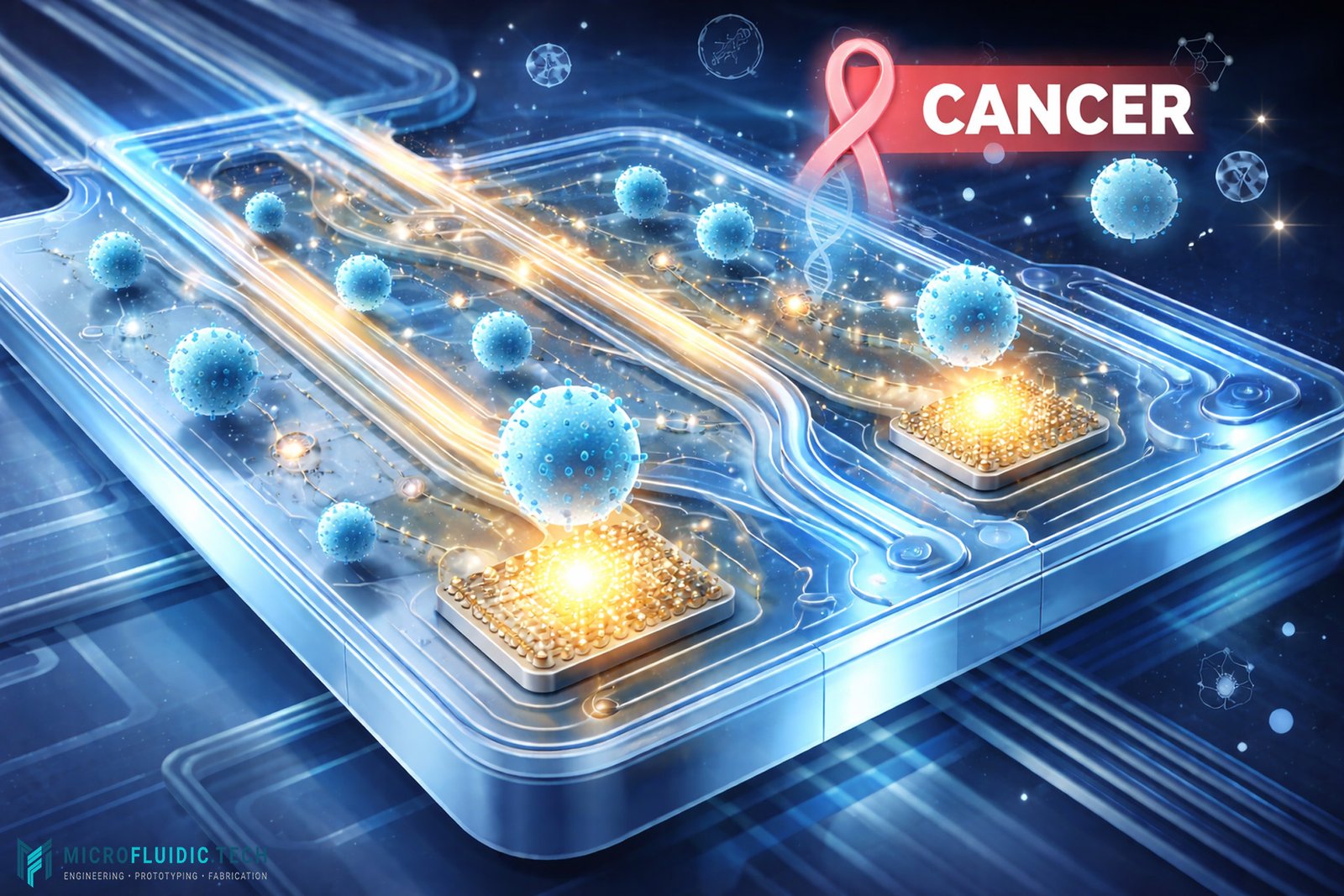
Recent advances in microfluidics are transforming cancer diagnostics, particularly through liquid biopsy technologies. A 2025 review in the International Journal of Molecular Sciences highlights how integrating microfluidics with nano-plasmonic sensing enables highly sensitive, label-free detection of extracellular vesicles (EVs)—a promising biomarker for early cancer detection.
What Is a Liquid Biopsy:
Traditional cancer diagnostics rely on invasive tissue biopsies, which are often painful, time-consuming, and not suitable for continuous monitoring. Liquid biopsy offers a minimally invasive alternative, analyzing biomarkers such as:
- Circulating tumor cells (CTCs)
- Cell-free DNA (cfDNA)
- Extracellular vesicles (EVs)
EVs are particularly valuable because they carry molecular information (proteins, RNA, DNA) directly from tumor cells, providing real-time insights into disease progression.
Role of Microfluidics in EV Isolation
Microfluidic systems significantly improve EV-based diagnostics by enabling:
- Precise fluid control at microscale
- Reduced sample volume requirements
- Faster processing times
- Integration of multiple analytical steps
These systems overcome limitations of conventional EV isolation techniques such as ultracentrifugation, which are labor-intensive and inefficient.
Nano-Plasmonic Detection
One of the most impactful innovations discussed in the paper is nano-plasmonic sensing, which enables:
- Label-free detection (no fluorescent tags required)
- Real-time monitoring of biomolecular interactions
- Ultra-high sensitivity at nanoscale
This technique leverages localized surface plasmon resonance (LSPR), where metallic nanostructures respond to changes in the local refractive index when EVs bind to the surface.
Key Advantages of the Technology
The integration of microfluidics with nano-plasmonic detection provides:
- Early cancer detection with high sensitivity
- Non-invasive monitoring of disease progression
- Reduced cost and faster turnaround times
- Potential for point-of-care diagnostics
These advantages make it highly suitable for clinical applications and personalized medicine.
Challenges and Future Directions
Despite its promise, several challenges remain:
- Standardization of EV isolation methods
- Scalability for clinical deployment
- Integration with existing healthcare workflows
- Need for large-scale validation studies
Future research is expected to focus on fully integrated lab-on-chip platforms combining EV isolation, detection, and data analysis in a single device.
Conclusion
Microfluidic liquid biopsy combined with nano-plasmonic sensing represents a major step toward rapid, accurate, and minimally invasive cancer diagnostics. As the technology matures, it has the potential to revolutionize early detection and enable continuous monitoring of cancer patients.
